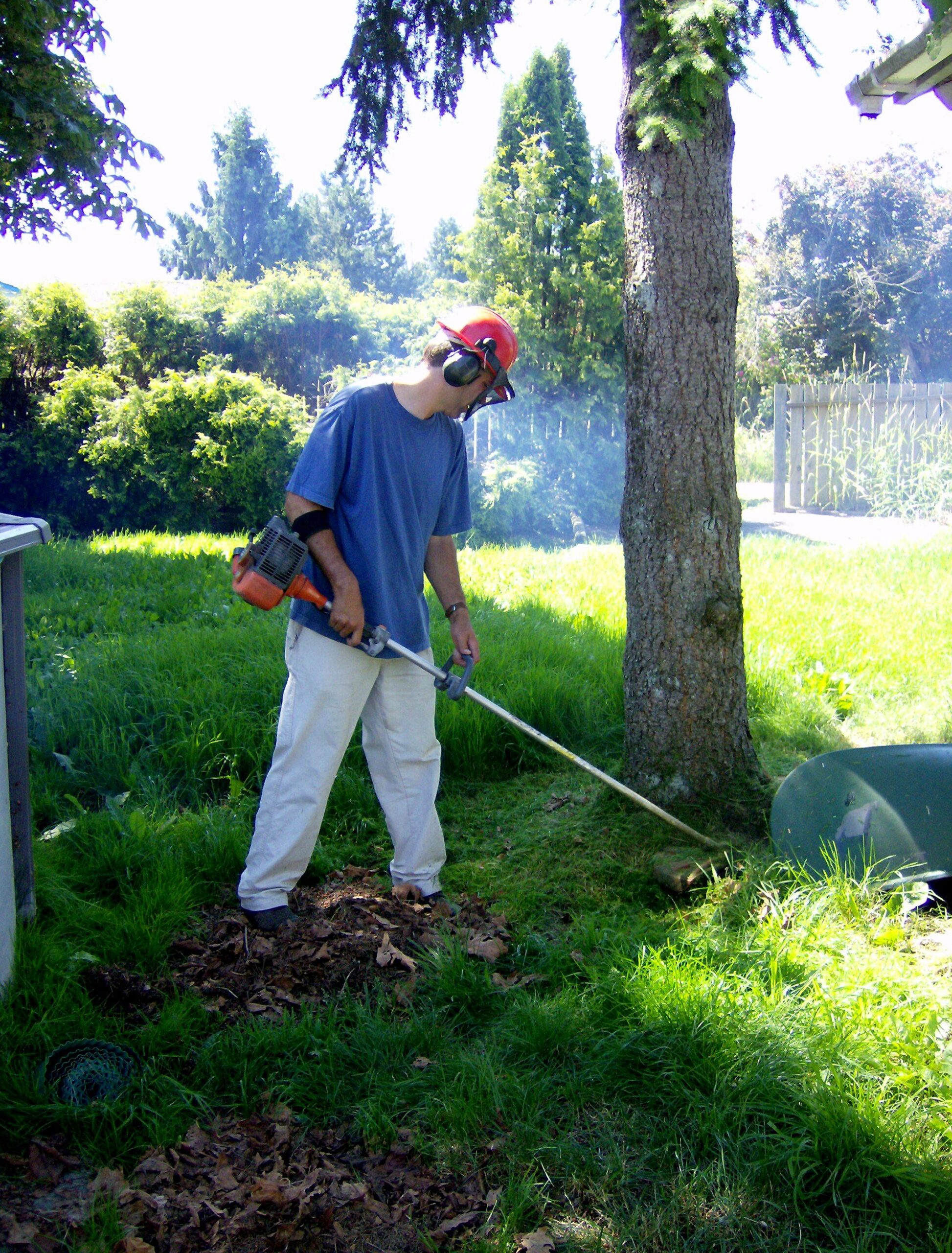
- Ensure your feet are shoulder-width apart for stability.
- Grasp the handle with one hand and the shaft with the other.
- Keep your back straight and bend slightly at the knees.
- Rest the string trimmer’s weight on your shoulder for comfort.
- Keep the trimmer at waist level and angle it towards the ground for efficient trimming.
Who would have thought that a seemingly simple task like holding a string trimmer requires technique and knowledge? I used to believe that too until I had my first experience with string trimmers. Understanding this is crucial – not only for efficient trimming but also for your safety.
We’ve grown accustomed to these trimming companions since they first emerged in the early 1970s by George Ballas. I find it fascinating that more than 75% of gardeners use string trimmers today in the US. This emphasizes the importance of knowing how to correctly hold and use them, which will ultimately minimize risks and maximize efficiency.
 Source: wikimedia.org
Grasping the Basics of Holding a String Trimmer
Often underestimated, the handling and operation of a string trimmer can dramatically influence its performance and your safety. Understanding ‘how to hold string trimmer?’ is the first step towards efficient lawn care. This comprehensive guide walks you through the steps to ensure your trimmer skills are top-notch.
Step-1: Get Familiar with Your String Trimmer
The first step towards mastering how to hold a string trimmer is knowing the tool itself. Depending upon the model, your string trimmer will have two distinct sections — the power source (engine) and the cutting head. The two are connected via a long shaft, typically equipped with a handle and a shoulder harness attachment point.
For powered trimmers, the engine may sit at the top end of the shaft, near the handle, or at the base, close to the cutting head. The design impacts the tool’s balance, which consequently affects how you will hold and control it.
The handle location and design can also vary. Some trimmers come with a loop handle, while others sport a bike handle — both offer different benefits and require different handling techniques.
Paying attention to these components will greatly help you understand the best way to grip and maneuver your specific string trimmer.
Step-2: Take a Proper Stance
Before you start trimming, take a moment to position yourself correctly. Stand straight, with your feet shoulder-width apart. This sturdy footing provides added stability and decreases fatigue during extended periods of trimming.
Bend your knees slightly and lean slightly forward to counterbalance the weight of the trimmer. Be conscious of your posture throughout. A bent back can lead to unnecessary strain and discomfort.
Remember, you are controlling the trimmer, not the other way around. By maintaining a firm yet comfortable stance, you ensure better control and efficiency when using your string trimmer.
Regular checkups and adjustments to your stance over time will be necessary to prevent strain and fatigue and ensure that you can operate your trimmer safely and efficiently.
Step-3: Grip the Handle or Handles Properly
Now that you’re standing correctly, it’s time to grasp the trimmer correctly. String trimmers typically have one or two handles, depending on the model. You must grasp these handles firmly but not too tightly to avoid fatigue and maintain control.
If you have a loop handle trimmer, hold the handle with one hand (your left if you are right-handed, and vice versa) and grasp the shaft near the engine with your other hand. Your fingers should wrap around the handle, and your thumbs should be on the opposite side to provide control and balance.
If your trimmer has bike handles, place one hand on each handle. Again, grip them firmly but comfortably, placing your thumbs underneath and your fingers around. This type of handle allows you greater control, especially when turning or maneuvering the trimmer.
Proper hand placement and grip form the critical basis for understanding ‘how to hold string trimmer?’ correctly. Shuffling your grip during the operation might lead to uneven cuts and risk injury.
Step-4: Utilize the Shoulder Harness
A shoulder harness or strap is a vital accessory when it comes to safely and effectively using a string trimmer. It helps distribute the trimmer’s weight evenly, reducing strain on your arms and shoulders, and allowing more mobility.
Put the strap over your head onto your shoulder. The pad of the strap should sit comfortably on your shoulder, and the trimmer should hang just off your hip. Adjust the strap’s length to a position where you can easily reach the trimmer controls while maintaining a straight back.
If your trimmer does not come with a harness, it’s worth purchasing one. It is particularly beneficial for heavier trimmers or long-term trimming jobs. Using a shoulder harness not only improves control, precision, and comfort but also significantly reduces the risk of musculoskeletal problems.
A vital aspect of learning ‘how to hold string trimmer?’ lies in mastering the harness’s use. Familiarizing yourself with the shoulder harness and learning to use it effectively can drastically improve your trimming experience.
Step-5: Keep Your Arms in a Comfortable Position
The final step in effectively holding a string trimmer is to maintain a comfortable arm position. Your arms should be slightly bent at the elbows, relaxed, and not fully extended. A correct arm posture will prevent muscle strain and make trimming more manageable.
Your lead arm (the one holding the handle for loop handle trimmers or the front handle on bike handle trimmers) should be slightly lower than your other arm. This position allows for better control and maneuverability when swinging the trimmer from side to side.
Always maintain the same arm position during your trimming work, regardless of your trimmer’s design. This constant posture ensures that you have maximum control over the trimmer and allows you to use it proficiently.
Arm position often overlooked, plays a crucial role in ‘how to hold string trimmer?’ correctly. Proper arm function not only enhances control but also reduces the stress on your upper body, particularly during prolonged usage.
From understanding the trimmer’s layout to appropriate standing posture, correct grip, harness usage and comfortable arm position, each factor individually and collectively plays a crucial role in how to hold a string trimmer? On the surface, it may seem simple, but a proper grip and stance significantly impacts the efficiency of the tool and your safety. Master these steps and you’re on your way to becoming a proficient trimmer operator!
How to Use a String Trimmer – 10 Skills to Master
Frequently Asked Questions
Mastering the correct way to hold a string trimmer can mean the difference between a neatly-manicured lawn and a disaster zone. Here we provide some answers to frequently asked questions about this essential gardening task.
What is the ideal stance when using a string trimmer?
When you are using a string trimmer, it’s important to stand with your feet shoulder-width apart to maintain balance and ensure your safety. This position will also prevent you from straining your back during extended periods of use.
Keep your left hand on the handle located on the shaft of the trimmer and your right hand on the throttle controls. This balance will enable smooth handling and allow for easy maneuvering of the trimmer around various types of vegetation.
Should I use both hands to handle a string trimmer?
Yes, absolutely. Controlling the string trimmer with both hands will afford you greater stability, better control, and reduce the risk of accidental injury. Your dominant hand should be on the handle with the throttle controls while your other hand steadies the trimmer from the handle on the shaft.
It is also beneficial to use both hands when maneuvering the string trimmer to reach tight corners or navigate around obstacles in your garden or lawn.
What should I do with the control handle?
The control handle on your string trimmer is your main point of interaction with the tool. By pressing on the trigger located in the control handle, you can regulate the speed of the trimmer. This handle should always be gripped firmly with your dominant hand.
Some string trimmers come with adjustable handles. If yours has this feature, adjust the handle to a comfortable height and angle to match your stance and strength for more comfortable, efficient trimming.
Which direction should I be moving the string trimmer?
The direction in which you move your string trimmer can impact the final results of your trimming. Generally, it is advised to move the string trimmer from right to left. This direction ensures that cut grass and debris are expelled onto already trimmed areas, and not onto the untrimmed sections.
Note that if you are using a string trimmer with blades instead of a monofilament line, the cutting direction could be opposite. Always refer to your user manual to be sure of the correct operating procedures.
How should I hold the trimmer for different types of vegetation?
The manner in which you hold the string trimmer can vary depending on the type of vegetation. For example, for grassy areas, hold the trimmer close to the ground and make side-to-side sweeping movements. This method ensures an even cut across the grass bed.
For thicker vegetation, like bushes or heavy weeds, hold the trimmer at a slight angle and use a sawing motion. Be careful not to jam the trimmer into the vegetation, as this can cause the motor to work harder and become damaged.
Final Words
So, to wrap up, remember to hold the string trimmer with both hands and keep a firm grip to ensure effective control and reduce the chance of accidents. It’s necessary to maintain the trimmer at the ideal cutting height around 2 to 3 inches from the ground. This way, you can effectively trim all the unleveled lawns while reducing stress on your arm and wrist.
Remember, the right grip and posture are paramount in avoiding strain in the course of prolonged use. The proper use of a shoulder harness, if your string trimmer model comes with one, can help distribute the tool’s weight evenly and prevent discomfort. That’s all there is to it. With these tips, you should be on your way to trimming like a pro! Happy gardening!