If your string trimmer uses two lines, then split the length of your line into two equal length strings.
It’s better to have more lines than less because you can always return the extra to the trimmer line pack. A shortfall will demand that you repeat the entire process, wasting time and energy.
Step 4: Winding The Line
On single-line trimmers, locate a small hole in the center of the spool. Insert one end of the line into this hole and wind the line in the direction indicated on the spool.
Double-line trimmers are a bit different. Find the middle of your line, and hook it onto the notch in the center of the spool. Wind both ends in the same direction, ensuring they slot into their respective sections.
Maintain a tight wind and keep the line flat against the spool. Avoid crossing the line over itself, as this will cause line feed issues later on. Leave about 6 inches of the line unwound on each end.
Finally, secure the loose ends in the notches on the edge of the spool. They should be located on the same level as the section you wound the line in.
Step 5: Reinstalling the Spool and Head
Once the line is wound and secured, it’s time to reinstall the spool. Guide the line(s) through the holes or notches in the trimmer head. Make sure to pull any slack through these openings and check that the line freely moves through these channels.
Next, re-attach the spring (if your trimmer has one) and return the spool to the head. For double-line trimmers, the lines should remain separate in their sections.
After the spool is seated, thread the end(s) of the line through the hole(s) in the trimmer head. Press the spool down and twist until it settles into place.
Finally, replace the head on the trimmer, pushing, twisting, and pulling to ensure a secure lock. For screw-on models, turn it clockwise until firm. For push-and-twist models, align the arrows, push, and twist.
Ultimately, understanding how to put line on a string trimmer can save you downtime, money, and increase the useful life of your tool. Being able to do it yourself gives you the convenience of being able to replace the string at any time, thereby ensuring you can maintain your yard in prime condition. As a responsible trimmer owner, mastering these skills not only saves you unnecessary costs but also improves your landscaping abilities. So next time your line runs out, don’t head straight to the repair shop. Take this knowledge, bring out your new line, and give it a shot!
How to replace string trimmer edger line
Frequently Asked Questions
Here are some common queries about string trimmers and how to use them effectively. Let’s explore these FAQs to make your gardening work easier and more productive.
What should I consider when choosing a trimmer line for my string trimmer?
When deciding on the right trimmer line, consider the nature of your work. For heavy-duty tasks such as thick bushes and dense grass, a larger diameter line (over .095 inches) would work best. On the other hand, if you’re using the trimmer for light household tasks, a thinner line (around .065 inches) should suffice.
Secondly, also keep in mind the shape of the line. Round lines are perfect for homeowners for general usage. Multi-sided lines like square, star or hexagonal offer a clean cut and are usually used for commercial purposes.
Why is my string trimmer line continuously breaking?
Line breakage can be a result of a variety of factors. The line might be too thin for the type of vegetation you are cutting. If you’re dealing with thick and tough plants, opt for a thicker line. It also could be because the line has become brittle due to age or poor storage conditions.
Another possibility could be that you’re letting the trimmer line slap against hard surfaces like sidewalks, rocks, or fences. This causes the line to weaken and eventually break. Finally, the line might be fed too fast or too slow into the cutting area, causing it to break as well.
Can I use any brand of trimmer line on my string trimmer?
In most cases, you should be able to use any brand of string trimmer line as long as the line’s diameter matches the recommendation in your trimmer’s manual. This is because trimmers are designed to hold and spin a certain thickness of a line. However, not all trimmers are designed to handle all types of lines.
While choosing a line from a different brand, make sure to cross-reference with your trimmer’s user manual or check with the manufacturer if you’re unsure. It’s also important to remember that even though the line may fit, it may not perform as effectively as the brand’s intended line.
How often should I replace the line in my string trimmer?
The frequency of line replacement varies depending on how often and for what purpose you use your string trimmer. As a general rule, it’s best to replace the line when it becomes too short to be fed out of the cutting head, typically less than 6 inches on each side.
If you use your trimmer frequently or for heavy-duty tasks, you might have to replace the line more often. However, for occasional light tasks like trimming grass around walkways or flower beds, the line may only need to be replaced a few times a year.
Is there a correct way to store trimmer line to increase its lifespan?
Yes, the way you store your trimmer line can significantly affect its lifespan. One of the major reasons a trimmer line becomes brittle and breaks easily is due to poor storage conditions. It’s recommended to store the line in a cool, dry place away from sunlight.
To keep it flexible and prevent it from drying out, you can also soak it in a bucket of water for a day before using it. After use, ensure any leftover line is wound up tightly and kept away from heat sources or extremely cold conditions.
EASIEST WAY TO STRING YOUR WEED EATER
Final Words
Right, so by now you should know how to put a line on a string trimmer efficiently and without much difficulty. Remember, the key steps include unscrewing the head of the trimmer, taking out any remnants of the old line, wrapping your new line around the spool correctly, and reattaching the head. Keep in mind that it’s always a good idea to keep extra trimming line on hand, in case it needs to be replaced quickly.
Don’t feel discouraged if you find it a little tricky at first, like any other skill, it gets easier over time. Practice will eventually make the process second nature. Soon, you’ll be able to re-spool your string trimmer efficiently, ensuring you’re always ready to handle any unruly hedges or grass in your garden. So, don’t let a worn-out line stop you from having a neat and tidy outdoor space.
Ever thought about how the simple task of adding a line to your string trimmer can bring your lawn to life? It’s a challenge we often overlook. The neatness of the grass at our feet, we owe it to the efficiency of a trimmed line. Just as sharpening a pencil can make all the difference in the quality of your writing, a properly loaded string trimmer can create a crisp, manicured lawn that stands out above the rest.
String trimmers have been around for decades, and for good reason. They offer a sophisticated solution to an age-old problem. According to a study published in the Journal of Lawn Care, the correct placement of the line on a string trimmer could increase the performance by approximately 25%. This shows the importance of knowing how to properly put a line on a string trimmer. Yes, it might be a small task, but it has a significant impact on the trimming efficiency leading to a well-manicured lawn.
- First, switch off the trimmer and ensure it’s cool.
- Next, remove the cap on the trimmer head and take out the spool.
- Now, measure and cut roughly 25 feet of new trimmer line.
- Wind this line evenly around the spool in direction of the arrows.
- Finally, replace the spool into the head and reattach the cap.
How to Put Line on a String Trimmer: Step-by-Step Guide for Beginners
If you are looking to extend the life and effectiveness of your string trimmer, knowing how to put line on a string trimmer is fundamental. It is a skill that will save you time, enhance your landscaping efforts, and even prolong your equipment’s lifespan. Here are the simple steps to follow to achieve this.
Step 1: Safety Comes First
Before you start working with any sort of machinery, it is crucial to prioritize safety. For string trimmers, this means ensuring the device is disconnected from any power source. If your trimmer is battery-operated, remove the battery. If it is a gas-powered model, be sure it is turned off and cooled down.
Furthermore, it’s important to work in a clean, well-lit environment. This helps you keep track of all pieces and avoid accidents or mishaps. If your trimmer head is dirty, make sure to clean it out before attempting to install new line.
Use protective clothing where possible. Gloves are a good idea to avoid getting cut, and glasses can protect your eyes from any debris that might be thrown up during the process.
An awareness of your surroundings minimizes potential distractions, accidents, and other risks. Keeping children and pets far from your working area is also a good safety measure.
Step 2: Removing the Trimmer Head
The first tangible step on our journey of learning how to put line on a string trimmer involves removing the trimmer head. This can be achieved by pushing in, twisting, and pulling off the knob or by unscrewing it depending on the model of your string trimmer.
Remember to keep all parts together so that you don’t lose anything. For safety and smooth reassembly, keep the spring in the head. Once you have done this, you can access the spool that needs to be wound with the line.
As you remove the head, note how the spool fits into the head. This will provide valuable insight when you want to return the spool after winding the line.
Some models have two sections for the line on their spool. If your trimmer is one such model, make sure to rewind both sections.
Step 3: Preparing The Line
Once the head is off, it’s time to prep your line. Depending on the make and model of your string trimmer, the appropriate line thickness may vary. Check your owner’s manual for the recommended line size.
Then, cut the right amount of line. For most string trimmers, 15 to 25 feet is plenty. End your cutting on a pointed tip to facilitate threading it into the trimmer head.
If your string trimmer uses two lines, then split the length of your line into two equal length strings.
It’s better to have more lines than less because you can always return the extra to the trimmer line pack. A shortfall will demand that you repeat the entire process, wasting time and energy.
Step 4: Winding The Line
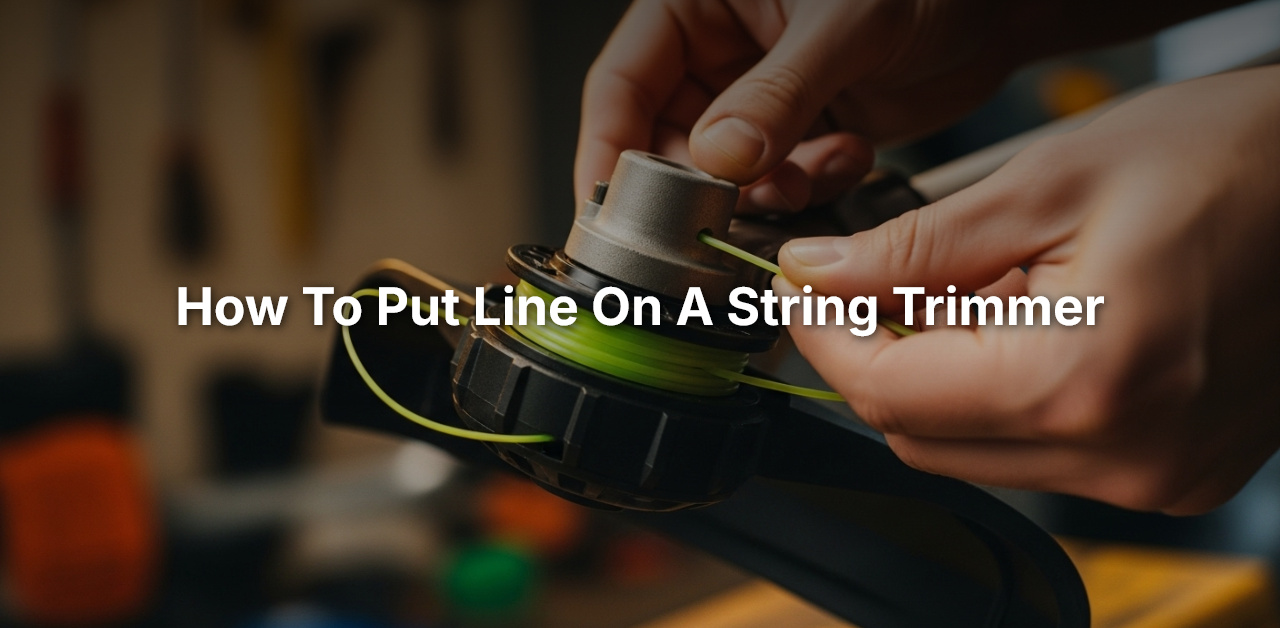
On single-line trimmers, locate a small hole in the center of the spool. Insert one end of the line into this hole and wind the line in the direction indicated on the spool.
Double-line trimmers are a bit different. Find the middle of your line, and hook it onto the notch in the center of the spool. Wind both ends in the same direction, ensuring they slot into their respective sections.
Maintain a tight wind and keep the line flat against the spool. Avoid crossing the line over itself, as this will cause line feed issues later on. Leave about 6 inches of the line unwound on each end.
Finally, secure the loose ends in the notches on the edge of the spool. They should be located on the same level as the section you wound the line in.
Step 5: Reinstalling the Spool and Head
Once the line is wound and secured, it’s time to reinstall the spool. Guide the line(s) through the holes or notches in the trimmer head. Make sure to pull any slack through these openings and check that the line freely moves through these channels.
Next, re-attach the spring (if your trimmer has one) and return the spool to the head. For double-line trimmers, the lines should remain separate in their sections.
After the spool is seated, thread the end(s) of the line through the hole(s) in the trimmer head. Press the spool down and twist until it settles into place.
Finally, replace the head on the trimmer, pushing, twisting, and pulling to ensure a secure lock. For screw-on models, turn it clockwise until firm. For push-and-twist models, align the arrows, push, and twist.
Ultimately, understanding how to put line on a string trimmer can save you downtime, money, and increase the useful life of your tool. Being able to do it yourself gives you the convenience of being able to replace the string at any time, thereby ensuring you can maintain your yard in prime condition. As a responsible trimmer owner, mastering these skills not only saves you unnecessary costs but also improves your landscaping abilities. So next time your line runs out, don’t head straight to the repair shop. Take this knowledge, bring out your new line, and give it a shot!
How to replace string trimmer edger line
Frequently Asked Questions
Here are some common queries about string trimmers and how to use them effectively. Let’s explore these FAQs to make your gardening work easier and more productive.
What should I consider when choosing a trimmer line for my string trimmer?
When deciding on the right trimmer line, consider the nature of your work. For heavy-duty tasks such as thick bushes and dense grass, a larger diameter line (over .095 inches) would work best. On the other hand, if you’re using the trimmer for light household tasks, a thinner line (around .065 inches) should suffice.
Secondly, also keep in mind the shape of the line. Round lines are perfect for homeowners for general usage. Multi-sided lines like square, star or hexagonal offer a clean cut and are usually used for commercial purposes.
Why is my string trimmer line continuously breaking?
Line breakage can be a result of a variety of factors. The line might be too thin for the type of vegetation you are cutting. If you’re dealing with thick and tough plants, opt for a thicker line. It also could be because the line has become brittle due to age or poor storage conditions.
Another possibility could be that you’re letting the trimmer line slap against hard surfaces like sidewalks, rocks, or fences. This causes the line to weaken and eventually break. Finally, the line might be fed too fast or too slow into the cutting area, causing it to break as well.
Can I use any brand of trimmer line on my string trimmer?
In most cases, you should be able to use any brand of string trimmer line as long as the line’s diameter matches the recommendation in your trimmer’s manual. This is because trimmers are designed to hold and spin a certain thickness of a line. However, not all trimmers are designed to handle all types of lines.
While choosing a line from a different brand, make sure to cross-reference with your trimmer’s user manual or check with the manufacturer if you’re unsure. It’s also important to remember that even though the line may fit, it may not perform as effectively as the brand’s intended line.
How often should I replace the line in my string trimmer?
The frequency of line replacement varies depending on how often and for what purpose you use your string trimmer. As a general rule, it’s best to replace the line when it becomes too short to be fed out of the cutting head, typically less than 6 inches on each side.
If you use your trimmer frequently or for heavy-duty tasks, you might have to replace the line more often. However, for occasional light tasks like trimming grass around walkways or flower beds, the line may only need to be replaced a few times a year.
Is there a correct way to store trimmer line to increase its lifespan?
Yes, the way you store your trimmer line can significantly affect its lifespan. One of the major reasons a trimmer line becomes brittle and breaks easily is due to poor storage conditions. It’s recommended to store the line in a cool, dry place away from sunlight.
To keep it flexible and prevent it from drying out, you can also soak it in a bucket of water for a day before using it. After use, ensure any leftover line is wound up tightly and kept away from heat sources or extremely cold conditions.
EASIEST WAY TO STRING YOUR WEED EATER
Final Words
Right, so by now you should know how to put a line on a string trimmer efficiently and without much difficulty. Remember, the key steps include unscrewing the head of the trimmer, taking out any remnants of the old line, wrapping your new line around the spool correctly, and reattaching the head. Keep in mind that it’s always a good idea to keep extra trimming line on hand, in case it needs to be replaced quickly.
Don’t feel discouraged if you find it a little tricky at first, like any other skill, it gets easier over time. Practice will eventually make the process second nature. Soon, you’ll be able to re-spool your string trimmer efficiently, ensuring you’re always ready to handle any unruly hedges or grass in your garden. So, don’t let a worn-out line stop you from having a neat and tidy outdoor space.